Technical resources
Water treatment glossary
Clear definitions of the terms found in water analyses, data sheets and quotations for softening, reverse osmosis, filtration and UV disinfection.
Hardness and softening
- Water hardness
- The concentration of calcium and magnesium dissolved in water. It causes scale when water is heated and is expressed in °f, °dH or mg/L CaCO3.
- Scale
- Mineral deposits, mainly calcium carbonate, that form when hard water is heated or evaporates. Scale reduces heat transfer and blocks valves and nozzles.
- French degree (°f)
- Hardness unit used notably in France, Belgium and Switzerland. 1 °f corresponds to 10 mg/L of calcium carbonate.
- German degree (°dH)
- Hardness unit used notably in Germany, Austria and the Netherlands. 1 °dH corresponds to about 17.8 mg/L of calcium carbonate, or 1.78 °f.
- Residual hardness
- The hardness left after treatment, usually set with a mixing valve that blends softened and untreated water.
- Ion exchange
- The process used by softeners: calcium and magnesium ions in the water are exchanged for sodium ions held on a resin bed.
- Resin
- Small polymer beads carrying the exchange sites of a softener. The resin volume determines how much hardness can be treated between regenerations.
- Regeneration
- The cycle that restores the resin by rinsing it with brine. It can be triggered by time, by metered volume or, in Kinetico twin-tank systems, by the volume of water actually treated.
- Brine
- A concentrated salt solution prepared in the brine tank and drawn into the resin tank during regeneration.
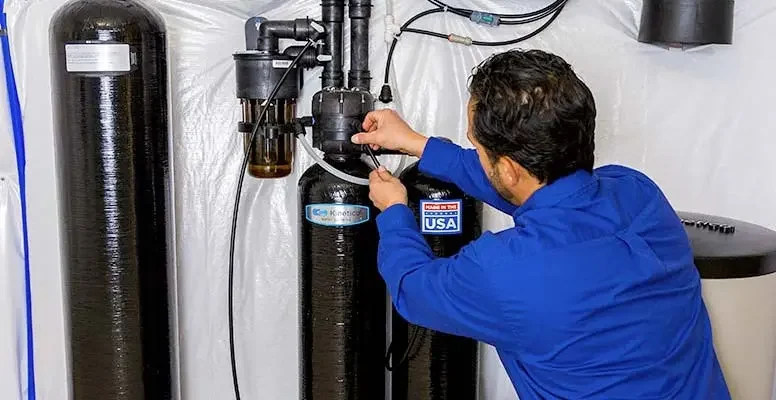
- Twin-tank (duplex) softener
- A softener with two resin tanks: one is in service while the other regenerates, so softened water is available continuously.
- Multiplex installation
- Several softener columns working in parallel or in alternation to cover high flows and continuous operation, for example triplex or quadruplex systems.
- Exchange capacity
- The quantity of hardness a volume of resin can treat before it must be regenerated, often expressed in °f·m³ per litre of resin.
Flow and sizing
- Peak flow
- The highest simultaneous flow demanded by the installation, in m³/h or L/min. It determines the hydraulic size of the equipment.
- Pressure drop
- The pressure lost as water flows through a treatment unit. Manufacturers state flows at a given pressure drop, for example 1 bar.
Reverse osmosis
- Reverse osmosis
- A membrane process that reduces dissolved salts by pushing water under pressure through a semi-permeable membrane.
- Permeate
- The treated water produced by a reverse osmosis membrane.
- Concentrate
- The flow that carries the rejected salts away from a reverse osmosis membrane to the drain, also called reject.
- Recovery rate
- The share of feed water converted into permeate, expressed as a percentage.
- TDS (total dissolved solids)
- The total quantity of minerals and salts dissolved in water, in mg/L. It is often estimated from conductivity.
- Conductivity
- The ability of water to conduct electricity, in µS/cm. It rises with the dissolved salt content and is used to monitor reverse osmosis performance.
- Blending
- Mixing a controlled share of filtered feed water with permeate to reach a target mineral content, for example for coffee or steam equipment.
UV disinfection
- UV disinfection
- A physical treatment in which UV-C light at 254 nm inactivates microorganisms in the water flowing through a reactor, without adding chemicals.
- UV dose
- The ultraviolet energy received by the water, expressed in mJ/cm². It depends on lamp output, flow and UV transmittance.
- UV transmittance (UVT)
- The percentage of UV light at 254 nm that passes through 1 cm of water. A low UVT reduces the dose delivered at a given flow.
- Quartz sleeve
- The transparent tube that separates the UV lamp from the water while letting ultraviolet light through. Deposits on its surface reduce the dose.
- UV sensor
- A device that measures the UV intensity reaching the water and triggers an alarm, or closes a solenoid valve, when it falls below a set point.
Filtration
- Sediment filtration
- Mechanical filtration that retains particles such as sand and rust. Cartridges are rated by the particle size they retain, in microns.
- Micron rating
- The particle size a cartridge is designed to retain. One micron equals one thousandth of a millimetre; 5 microns is common upstream of UV systems.
- Activated carbon
- A porous filter medium that reduces chlorine, taste and odour by adsorption. It also protects reverse osmosis membranes from chlorine.
Related pages
Need help interpreting a water analysis?
Send us the report and a short description of your site; we will explain what it means for your equipment.