KineticoPRO filtration
Commercial water filters
Find commercial water filters and filter cartridges for coffee machines, foodservice and other professional applications. Choose the filtration media and flow rate for the incoming water and connected equipment.
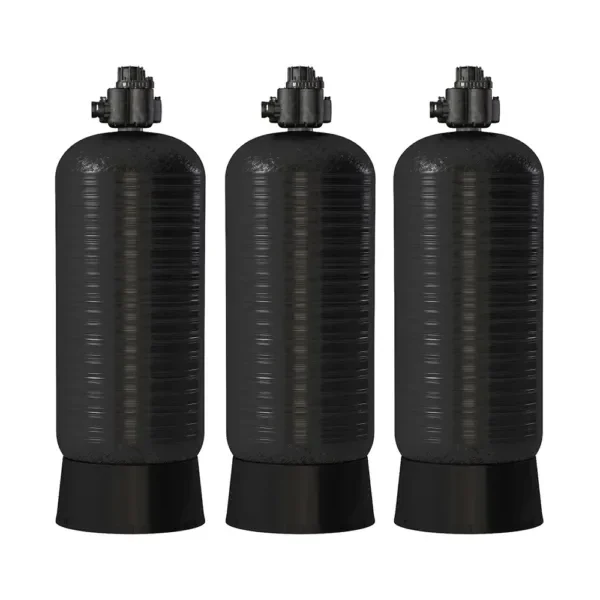
How to choose a commercial water filter
Filtration is selected according to what must be retained and where. Sediment filters protect valves, softeners, UV chambers and appliances from sand, rust and particles; activated carbon reduces chlorine, taste and odour before coffee machines, ovens and drinking water points; specialised cartridges target contaminants such as lead.
Filtration rating is expressed in microns (µm). Coarse filters of 100 to 320 µm protect a whole installation at the building inlet, 20 to 50 µm cartridges are common before equipment, and 1 to 5 µm cartridges are used ahead of UV systems and reverse osmosis.
Flow and pressure drop matter as much as fineness. A cartridge that is too small for the flow clogs quickly and lowers the pressure at the outlets, so the housing format (for cartridges with nominal lengths of 254 or 508 mm, slim or large diameter) and the connection size are chosen from the peak flow.
Data to collect before choosing
- Peak flow and connection diameter at the filter location.
- What must be retained: sand and particles, chlorine taste and odour, or a specific contaminant.
- The equipment downstream and its manufacturer requirements: coffee machine, oven, UV chamber or membrane.
- Water pressure, and whether a pressure regulator is needed.
- Acceptable maintenance: cartridge replacement interval or a cleanable filter.
- Space around the housing to change cartridges easily.
Our filtration ranges
| Product family | Filtration | Connections or format | Typical use |
|---|---|---|---|
| Filtermax | 100 or 320 µm, with or without pressure regulator | 3/4″ to 2″ | Protection of a building or installation inlet |
| Kinetico prefilter | Sediment prefiltration upstream of treatment systems | 3/4″ to 2″ | Before softeners and filtration systems |
| VIQUA filter housings | Housings for cartridges with nominal lengths of 254 and 508 mm, valve-in-head or pressure release | 3/4″ and 1″ FNPT connections | Prefiltration before UV and point-of-use treatment |
| VIQUA sediment cartridges | 1 to 50 µm; polypropylene, dual-gradient, wound cotton or string-wound | Nominal lengths of 254, 508, 762 and 1,016 mm | Particle retention before UV, reverse osmosis and appliances |
| VIQUA carbon cartridges | Taste and odour reduction; PB versions also address lead | Nominal formats of 254 and 508 mm | Coffee, drinking water points and ice makers |
Ratings, formats and compatibilities are taken from the manufacturers’ data on each product page. Replacement cartridges are listed with the housings they fit.
Product sheets
Frequently asked questions about commercial water filtration
Which micron rating should I choose?
Start from the most sensitive equipment downstream. Building inlets are protected at 100 to 320 µm, appliances with 20 to 50 µm cartridges, and UV systems or membranes with finer 1 to 5 µm cartridges, often in two stages to spread the load.
How often should cartridges be changed?
It depends on the water and the volume filtered. Sediment cartridges are replaced when the pressure drop increases; carbon cartridges are replaced on a time or volume basis, because their adsorption capacity is used up before they clog.
Does activated carbon soften water?
No. Activated carbon reduces chlorine, taste and odour but does not change hardness. Where scale is a concern, a softener or a treatment adapted to the equipment is added.
Why install filtration before UV?
Particles shield microorganisms from UV light and foul the quartz sleeve. A fine sediment prefilter keeps the UV dose effective and extends maintenance intervals.
What is the difference between a coarse inlet filter and a cartridge filter?
Coarse inlet filters of 100 to 320 µm protect the whole installation from sand and debris and are usually cleaned rather than replaced. Cartridge filters retain finer particles close to the equipment and are replaced periodically.
Related pages
Filtration enquiry
Explain what the filter needs to treat and which equipment receives the water.
Fields marked with an asterisk are required.