KineticoPRO reverse osmosis
Commercial reverse osmosis systems
Explore commercial reverse osmosis systems for process water, hospitality and professional equipment. Compare the Purecleer ranges using the required water quality and production capacity.
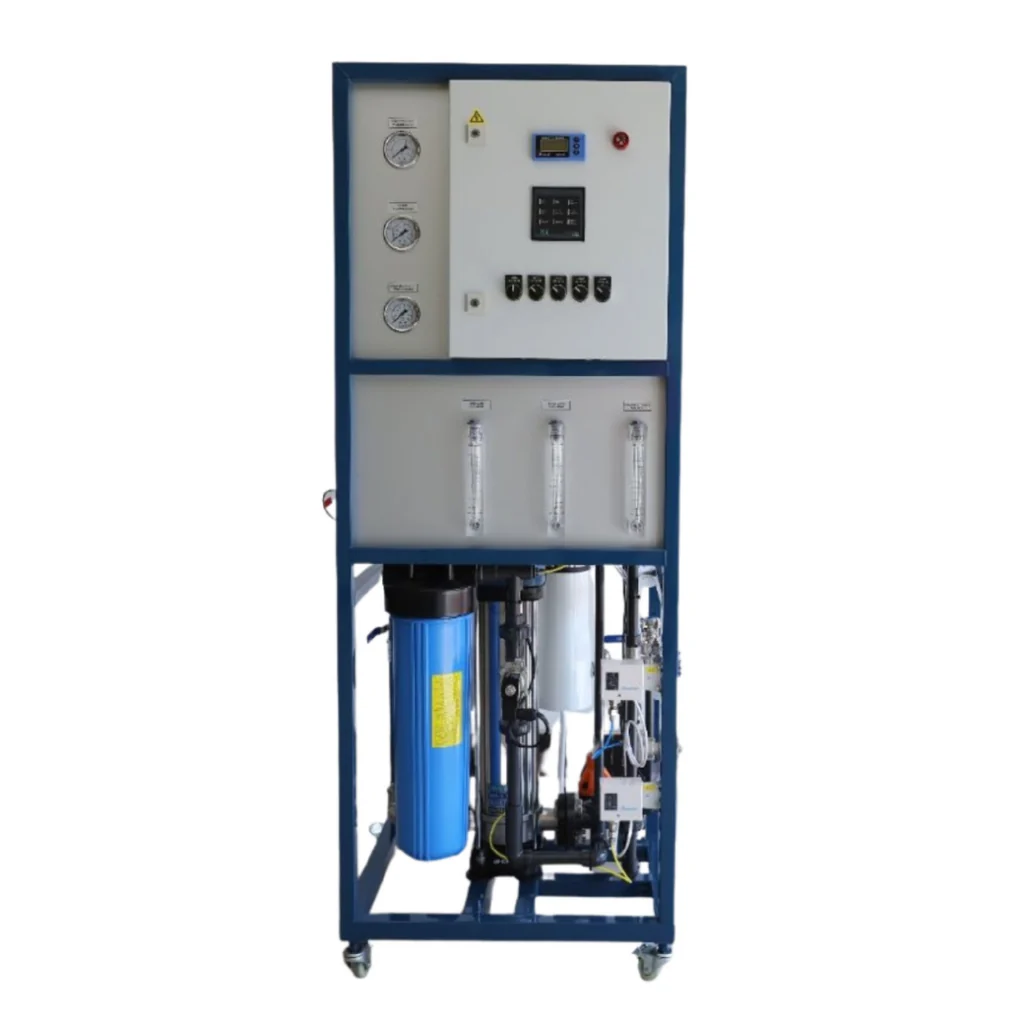
How to size a professional reverse osmosis system
Reverse osmosis pushes water through a semi-permeable membrane that separates most dissolved salts. It is chosen when an application needs low and stable conductivity: espresso machines, combi-steam ovens, glass and dishwashing rinse, laboratories, humidification and some production processes.
Sizing starts from the daily volume of permeate and the peak draw. Production is rated at a reference temperature, often 15 °C: colder feedwater lowers output, so winter conditions must be taken into account. Feedwater salinity (TDS), hardness, iron and chlorine determine the pretreatment needed to protect the membranes.
Recovery is the share of feedwater that becomes permeate. A higher recovery saves water but concentrates salts on the membrane, so it is adjusted to the feedwater quality. On the Purecleer COMPACT ranges, recovery is adjustable up to 75% depending on feedwater and operating conditions.
Data to collect before sizing
- Required permeate volume per day and per hour, including the peak draw.
- Water analysis: TDS or conductivity, hardness, iron, manganese and free chlorine.
- Feedwater temperature range over the year and available inlet pressure.
- Target quality at the point of use, for example a conductivity range or remineralised water for coffee.
- Storage needs: direct-flow production or a buffer tank, and the number of draw points.
- Drain capacity for the concentrate and space for the frame and pretreatment.
Our reverse osmosis ranges
| Range | Production | Key characteristics | Typical use |
|---|---|---|---|
| Kinetico RO Compact 1, 2 and 3 | 160, 300 and 420 L/h at 15 °C (feedwater TDS 500 mg/L) | Compact frames; 66 L tank on Compact 2 and 3 | Coffee shops, restaurants and small laboratories |
| Kinetico Purecleer SLIM HL | 200 or 400 L/h (4,800 or 9,600 L per 24 h) | Vertical frame, 1–2 membranes in 4040 format, feedwater salinity up to 3,500 ppm | Hotels, commercial kitchens and humidification |
| Kinetico Purecleer COMPACT HL | 400 to 1,200 L/h (9,600 to 28,800 L per 24 h) | 2–6 membranes in 4040 format, electronic pump control, recovery adjustable up to 75% | Central kitchens, laundries and process water |
| Kinetico Purecleer COMPACT L | 380, 760 or 1,150 L/h | Feedwater salinity up to 6,000 ppm, 2, 4 or 6 membranes in 4040 format | Highly mineralised or brackish feedwater, industry |
| Commercial 1000 DF | 2.4 L/min | Direct flow, sediment and carbon block prefilter, Smart DOT control, inlet TDS up to 1,500 ppm | Drinking water points and beverage equipment |
Production values, salt rejection and operating limits are manufacturer data measured under reference conditions. The 99% salt rejection stated for Purecleer membranes applies to those conditions.
Product sheets
Frequently asked questions about professional reverse osmosis
What conductivity does reverse osmosis achieve?
It depends on the feedwater. With a manufacturer-stated salt rejection of 99% on Purecleer membranes, permeate conductivity is a small fraction of the feedwater value. For coffee and cooking, the permeate is often blended or remineralised to reach a target mineral content.
Is a softener or filter needed before the reverse osmosis unit?
In most cases, yes. Hardness, iron and chlorine shorten membrane life. A softener and activated carbon filtration are usually installed upstream, selected from the water analysis.
Why does production drop in winter?
Membrane output falls as water temperature falls. Kinetico RO Compact outputs, for example, are rated at 15 °C; colder water produces less permeate, so the system is sized for the lowest expected temperature.
What happens to the concentrate?
The concentrate carries the separated salts to the drain. Its flow depends on the recovery setting: the Commercial 1000 DF, for example, produces 2.4 L/min of permeate for 1 L/min of reject water.
How often are membranes replaced?
Membrane life depends on pretreatment, feedwater quality and operating hours. Prefilters are replaced periodically, and membranes when production or salt rejection falls below the expected values; regular conductivity monitoring shows when to intervene.
Related pages
Reverse osmosis enquiry
Describe the water quality required and the production needed for your application.
Fields marked with an asterisk are required.