KineticoPRO water softening
Commercial water softeners
Compare commercial water softeners for hotels, restaurants, buildings and industry. Select the system using water hardness, peak flow and daily demand; request an equipment quotation.
How to choose a commercial water softener
A commercial softener is sized on three figures: the hardness of the incoming water, the peak flow the installation must deliver and the daily volume to be treated. Hardness is expressed in French degrees (°f) or German degrees (°dH); 1 °dH equals about 1.78 °f.
Resin capacity is expressed in m³·°f. For example, a resin bed rated at 400 m³·°f treats about 13 m³ of water at 30 °f before it needs to regenerate. The daily volume and the hardness therefore set the regeneration frequency, and with it the salt and water consumption.
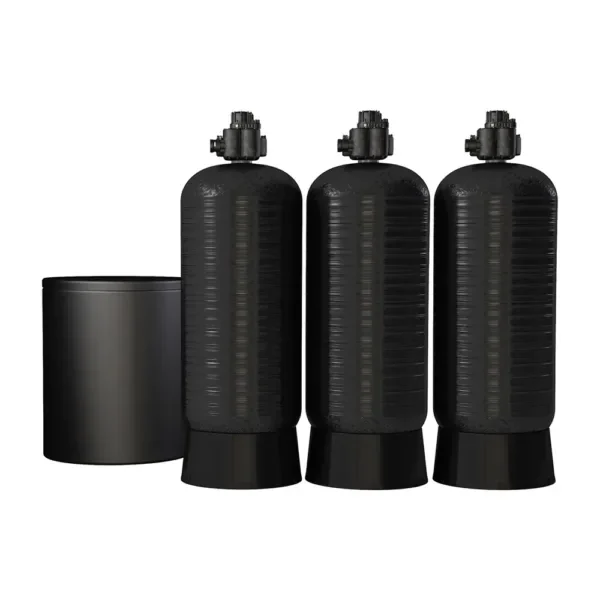
Continuity of service matters as much as capacity. Twin-tank and multi-column systems keep softened water available while one column regenerates, which suits hotels, kitchens, care homes and buildings that draw water around the clock.
Data to collect before sizing
- Incoming water hardness in °f or °dH, from a recent analysis or from the local water supplier.
- Peak flow in L/min or m³/h, measured when most outlets and appliances run at the same time.
- Daily consumption and operating hours, which set the regeneration frequency.
- Available pressure, pipe diameter and connection size at the installation point.
- Space for the columns and brine tank, access to a drain and a power supply if the controller is electronic.
- Target hardness at the outlet: many installations keep a residual hardness by blending rather than supplying fully softened water.
Our commercial softener ranges
| Range | Operating principle | Configurations | Typical use |
|---|---|---|---|
| KineticoPRO CP and CC Series | Twin tanks, non-electric hydraulic valve, regeneration on metered demand | Several models; maximum flow at ΔP = 1 bar listed per model (CC206c LT: 34.5 L/min) | Restaurants, hotels, offices and commercial premises |
| Kinetico Premier 2000s Series | Twin tanks, non-electric, Overdrive on OD models puts both tanks in service | Standard and OD variants | Small commercial premises and multi-unit buildings |
| Watermark WS simplex | One column, electronic Watermark control, countercurrent regeneration on most models | From 15 L of resin (WS470UF) to more than 850 L (WS755); connections from 1″ to 2″ | Workshops, laundries and processes that can accept a regeneration window |
| Watermark WS duplex | Two coordinated columns, countercurrent regeneration | From 2 × 15 L to 2 × 200 L of resin | Hotels, care homes and buildings that need continuous softened water |
| Watermark MTS 655 and MTS755 | Duplex, triplex or quadruplex columns coordinated by the MTS controller in alternating, parallel or peak-demand mode | MTS755 Duplex: 16,000 to 30,000 L/h optimal flow, up to 32,000 L/h peak | Industry, large buildings and sites with high peak demand |
Flow rates, resin volumes and dimensions come from the manufacturers’ data sheets published on each product page. Final sizing depends on your water analysis and consumption profile.
Product sheets
Frequently asked questions about commercial water softening
How often does a commercial softener regenerate?
It depends on the controller and on consumption. Kinetico twin-tank systems regenerate according to the volume of water actually used, while Watermark electronic controllers can be configured by volume, by time or by a combination of both.
Does a non-electric softener need a power supply?
No. KineticoPRO and Kinetico Premier twin-tank softeners use the energy of the flowing water to drive the control valve, so they operate without an electrical connection or programmable timer.
Simplex, duplex or multiplex: which configuration should I choose?
A simplex column suits sites that can accept a short regeneration window. Duplex and multiplex systems keep at least one column in service during regeneration and share peak demand, which is preferable for hotels, hospitals and continuous industrial processes.
Should all the water in a building be softened?
Not necessarily. Softening is usually applied to hot water production, kitchen and laundry equipment, boilers and cooling circuits, while drinking water points can keep a residual hardness. The treated circuits are defined together during the study.
What maintenance does a commercial softener require?
Regular salt refills in the brine tank, a periodic check of the outlet hardness and settings, and an annual inspection of the valve and resin. Consumables and spare parts are available in the professional catalogue.
Related pages
Water softening enquiry
Tell us the incoming hardness, the equipment to be supplied and the available flow information.
Fields marked with an asterisk are required.