VIQUA ultraviolet treatment
UV water disinfection systems
Explore VIQUA UV water disinfection systems and replacement UV lamps. Select the equipment using water quality, required flow and the manufacturer's operating conditions.
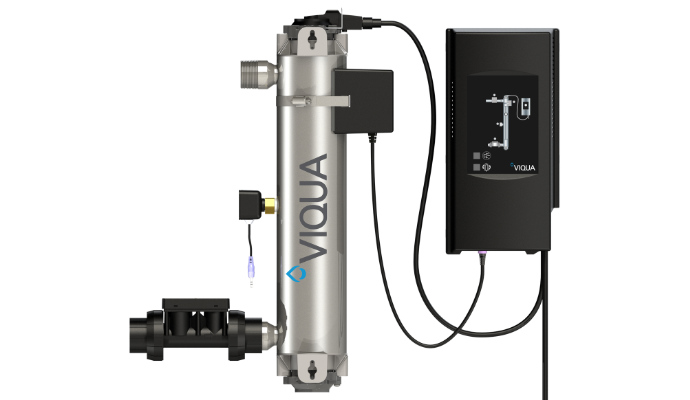
How to select a professional UV disinfection system
Ultraviolet treatment inactivates bacteria, viruses and protozoa by exposing them to UV-C light as the water flows through a chamber. It adds no chemicals to the water, but it has no residual effect in the pipework downstream.
A UV system is always sized for a flow at a given UV dose. In Europe the reference dose for drinking water is usually 40 mJ/cm² (400 J/m²), the value used by DVGW W 294 and ÖNORM M 5873; manufacturers also publish flows at 30 and 16 mJ/cm². Compare models at the same dose, UV transmittance and end-of-lamp-life conditions.
Water quality determines performance. UV transmittance (UVT), turbidity, hardness, iron and manganese affect how much UV light reaches the microorganisms and how quickly the quartz sleeve fouls. Sediment prefiltration is standard, and softening is recommended for hard water.
Data to collect before sizing
- Maximum flow through the UV chamber, not only the average consumption.
- Target UV dose required by the application or by local regulations.
- UV transmittance (UVT) of the water, or at least its turbidity, colour, iron and manganese values.
- Hardness, to decide whether softening is needed to protect the quartz sleeve.
- Monitoring requirements: UV sensor, alarms, dry contact to building management or a solenoid valve.
- Pipe size, space for lamp removal and electrical supply.
Our VIQUA UV ranges
| Range | Reference flow | Key features | Typical use |
|---|---|---|---|
| VIQUA VT and S2Q-PA | VT4: 9 L/min; S2Q-PA: 8 L/min at 40 mJ/cm² | Single-outlet systems; S2Q-PA with lamp countdown and audible alarm | Drinking water taps, dispensers and small kitchens |
| VIQUA VH | VH410: 130 L/min at 16 mJ/cm², 70 L/min at 30 mJ/cm² | Constant-current control; UV sensor on M versions, integrated prefiltration on F assemblies, -V versions for NSF/ANSI 55 Class B | Point of entry for small buildings, workshops and farms |
| VIQUA Arros | 34.1 to 83.3 L/min at 30 mJ/cm² (95% UVT, end of lamp life) | Touchscreen controller; dry-contact alarm output on -DC versions; IHS assemblies with integrated filtration | Point of entry for homes, small hotels and offices |
| VIQUA PRO | 38 to 189 L/min at 40 mJ/cm² | 316L stainless-steel chamber, amalgam lamp, UV sensor and CoolTouch fan; LightWise on PRO10 to PRO30 | Hotels, food businesses and commercial buildings |
| VIQUA VP and H / K | Up to 226 L/min at 40 mJ/cm² (K) | High-output or amalgam lamps; UV sensor on M, H+ and K+ versions | Commercial supplies and process water |
| VIQUA SHF and SHFM | 470 to 813 L/min at 40 mJ/cm² | Multi-lamp 316L chambers with a separate control panel; SHFM with continuous UV monitoring | Large buildings, industry and agriculture |
| VIQUA PRO24 | 90 L/min at 100 or 186 mJ/cm² | Configurations validated under the UVDGM protocol for 2-log or 4-log adenovirus reduction | Applications that require validated high doses |
Flows are manufacturer data at the stated dose, generally for 95% UVT at end of lamp life. Select a model at the dose your application requires.
Product sheets
Frequently asked questions about UV water disinfection
What UV dose do I need?
It depends on the application and on local rules. 40 mJ/cm² is the usual reference for drinking water in Europe and corresponds to NSF/ANSI 55 Class A, while 16 mJ/cm² corresponds to Class B supplemental treatment. Some applications require higher validated doses, such as those of the VIQUA PRO24.
How often must the UV lamp be replaced?
UV lamps lose output with operating time and are typically replaced once a year, even if they still light up. Controllers such as those of the VIQUA S2Q-PA and VH display a lamp countdown and signal when replacement is due.
Is prefiltration necessary?
Yes. Particles can shield microorganisms from UV light. A sediment prefilter is installed upstream of the chamber, and water that is hard or contains iron or manganese is treated first to keep the quartz sleeve clean.
Does UV treatment replace chlorination?
UV disinfects the water where it passes through the chamber but leaves no residual disinfectant in the network. In buildings it is combined with sound hydraulic design and, where regulations require it, a residual disinfectant.
Can a UV system be connected to building management?
Yes, on suitable models. Arros -DC versions provide a dry-contact alarm output, SHFM and the M versions of VH and VP include a UV sensor, and communication accessories are available for integration into building management systems.
Related pages
UV treatment enquiry
Tell us the water source, intended application and required flow.
Fields marked with an asterisk are required.